Deterministic AI: Patent Portfolio & Technology Summary
Eleven U.S. patents pending cover a full-stack deterministic computing architecture, including deterministic identity, deterministic payments, deterministic genomics, deterministic cellular networks, deterministic hardware execution layers, and the core Deterministic Computation Law (DCL).
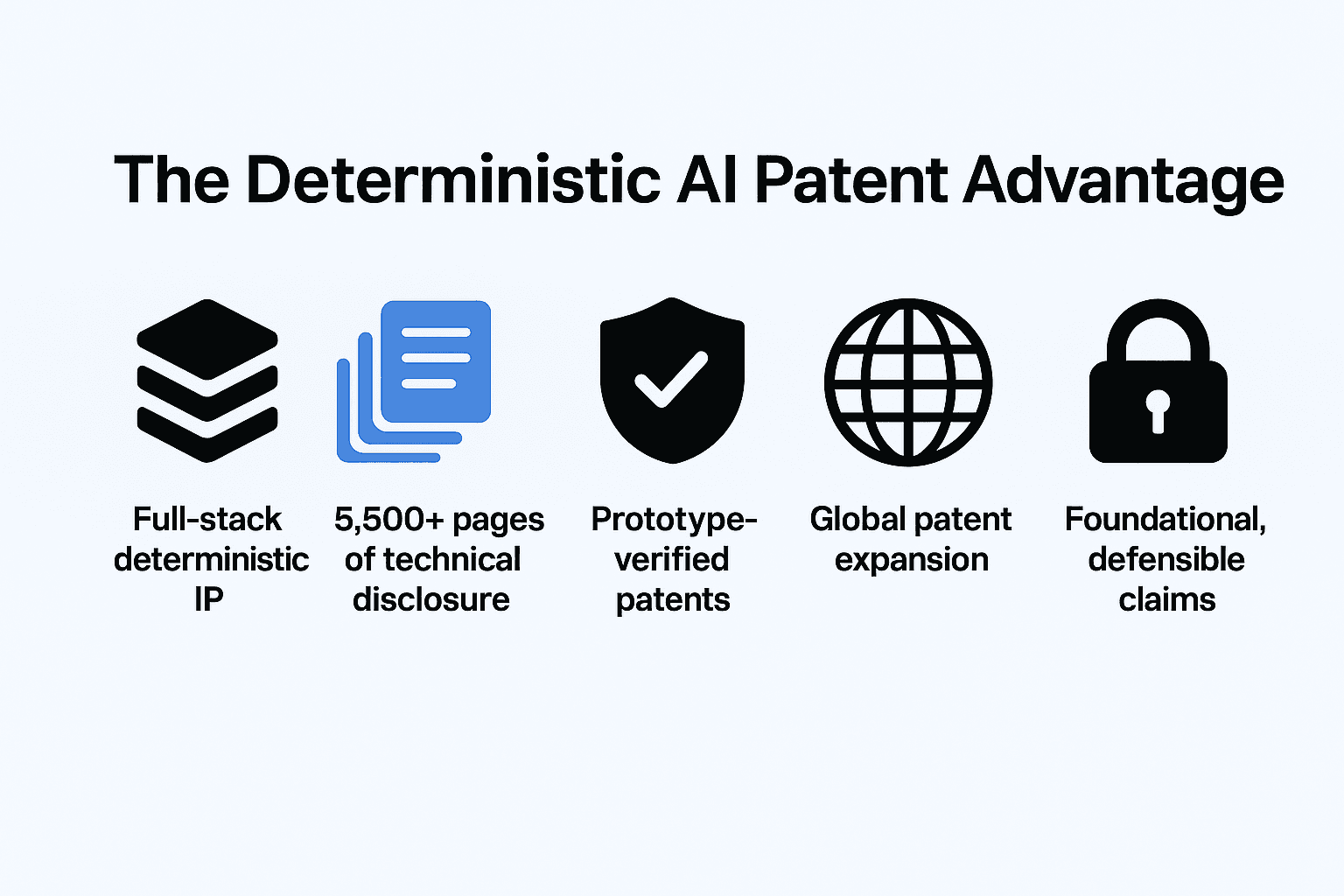
Collectively, these eleven filings contain over 5,500 pages of detailed specifications, system architectures, embodiments, and technical drawings, forming a comprehensive deterministic computing patent portfolio spanning software, hardware, and distributed systems. Core aspects of the disclosed technology are supported by working prototypes that have undergone independent technical validation.
Working, Machine-Verified Prototypes
All nine breakthroughs are powered by working deterministic AI prototypes with machine-verified reproducibility.
All results are fully repeatable and independently verifiable using published validation artifacts.
Core Patent Domains
- Deterministic Memory & Deterministic Retrieval (DRAG)
- Deterministic Compute-Skipping and Reuse Layers
- Deterministic Identity & Zero-Transmission Authentication
- Deterministic Payments, Smart Contracts & Settlement
- Deterministic Genomic Computing Engine (DGCE)
- Deterministic Cellular Networks (7G/8G Concepts)
- Deterministic Hardware Wrappers (ASIC / SoC)
- Deterministic AI Core Logic (DCL: R = H(D(P)))
Together, these domains address deterministic execution across AI systems, data centers, distributed networks, and emerging global infrastructure.
Core Patent Architecture Review
An independent technical review has evaluated the internal architectural consistency, cross-reference integrity, and reduction-to-practice evidence of the disclosed deterministic systems.
The full independent audit report is available for review under NDA upon request.
U.S. Patent Pending Numbers
63/889,596 · 63/896,794 · 63/901,714 · 63/910,966 · 63/913,994
63/915,135 · 63/917,171 · 63/918,347 · 63/918,887 · 63/927,653
63/941,442
Each filing secures priority for distinct layers of the deterministic computing stack, creating a cohesive, layered IP position across architecture, systems, and implementation levels.
Global Patent Strategy
The deterministic computing patent portfolio is being expanded internationally through the Patent Cooperation Treaty (PCT) process, followed by national-phase entry in key jurisdictions including the United States, Europe, Canada, Australia, India, China, Japan, Brazil, South Korea, Israel, South Africa, Singapore, and the Gulf Cooperation Council.
Additional continuations and expanded filings are planned to broaden protection of deterministic architectures, system embodiments, and implementation layers across software, hardware, and distributed environments.
PCT Filings Underway (Priority Date Secured)
With U.S. provisional priority established, the portfolio is progressing through the PCT international filing process, extending coverage to all PCT contracting states (over 150 countries) under the Paris Convention framework. National-phase filings in strategic markets will follow.
Patent Coverage Summary
The deterministic computing patent portfolio provides coverage across multiple layers of deterministic AI and computation, supported by extensive technical disclosure and validated prototypes. Coverage includes:
- deterministic preprocessing and canonicalization
- deterministic inference and retrieval (DRAG)
- deterministic long-term memory systems
- deterministic verification, hashing, and reproducibility mechanisms
- deterministic identity and authentication workflows
- deterministic financial, telecom, and genomic systems
- deterministic execution wrappers for AI models
- deterministic hardware wrappers and low-level acceleration concepts
Portfolio Characteristics
- Over 5,500 pages of detailed technical specifications, embodiments, and drawings
- Core embodiments implemented in working prototypes
- Independent technical validation demonstrating deterministic execution behavior
- Coverage spanning software, hardware, workflows, and distributed networks
- Extensive disclosure supporting enablement and claim breadth
- Foundational architectural claims suitable for enterprise-scale deterministic systems
Enterprise & Licensing Relevance
This patent portfolio provides an IP foundation for organizations seeking to integrate deterministic AI into mission-critical workflows where reproducibility, auditability, and controlled execution are required. Covered application areas include:
- AI model reliability and reproducibility
- cybersecurity and identity assurance
- financial settlement and compliance automation
- medical, genomic, and scientific reproducibility
- large-scale RAG, search, and enterprise knowledge systems
- data-center efficiency and compute reduction
- future deterministic telecom and distributed infrastructure
Commercial licensing, joint development, and enterprise evaluation are available upon request.
Enterprise Licensing Options
Deterministic AI technologies are available for global non-exclusive licensing, with optional sector-specific exclusivity, OEM hardware integration rights, joint development agreements, and multi-year enterprise licensing structures. Custom licensing arrangements may be tailored to market, product, or operational requirements.
Legal Notice
This page provides a high-level informational summary only. Full patent applications, claims, figures, and supporting materials are filed with the United States Patent and Trademark Office (USPTO). Validation activities relate to technical operation and prototype behavior and do not constitute legal opinions, patentability determinations, or regulatory approval. Additional continuations, CIPs, and PCT national-phase filings are in progress as part of the expanding deterministic computing patent family.