Why Enterprises License Deterministic AI
The Fastest Path to Stable, Auditable, and Cost-Efficient AI Systems
Deterministic AI enables enterprises to replace unpredictable, drift-prone AI behavior with deterministic execution, reproducible outputs, and audit-ready traceability - without retraining models or replacing existing AI infrastructure. The technology integrates as an external deterministic layer, allowing organizations to improve reliability, compliance posture, and operational efficiency while preserving their current AI investments.
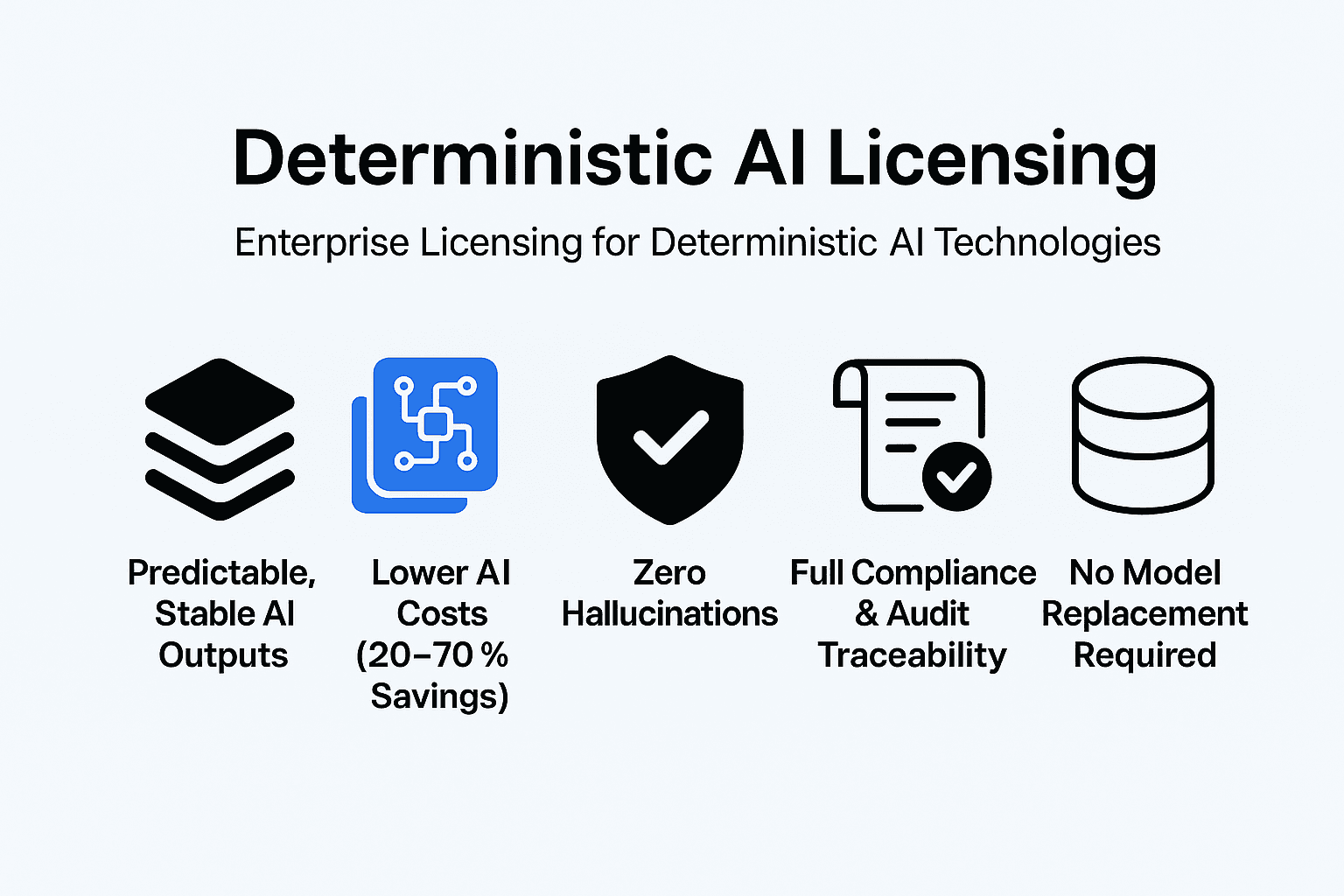
What Enterprises Gain Immediately
1. Predictable, Stable Outputs
Under defined deterministic execution conditions, identical inputs produce identical outputs across devices, clouds, versions, and sessions. This enables reproducible system behavior and enterprise-grade reliability for critical workflows.
2. Lower AI Costs (Up to 20–70% Savings)
Deterministic memory, canonicalization, and retrieval eliminate redundant inference and repeated computation across the AI stack.
- Reduced GPU and cloud utilization
- Faster system response times
- Infrastructure that scales more efficiently over time
Cost savings depend on workload characteristics and reuse potential.
3. Deterministic Outputs for High-Trust Workflows
When operating in deterministic mode with canonicalized inputs and verified memory, AI outputs are deterministically reproducible, consistent, and verifiable.
This makes deterministic AI suitable for high-stakes environments where output stability and traceability are required, including regulated and mission-critical use cases.
4. Compliance-Ready Audit Traceability
Deterministic AI automatically produces reproducible, tamper-evident execution records for every output.
Each result is replayable end-to-end, enabling:
- Audit-ready evidence
- Transparent reasoning reconstruction
- Reduced reliance on post-hoc logging or manual investigation
This supports regulatory review and internal governance across finance, healthcare, government, legal, defense, and other regulated sectors.
5. No Model Replacement Required
Deterministic AI integrates with existing AI systems, including:
- LLMs and foundation models
- RAG pipelines and vector databases
- Enterprise applications and workflows
The deterministic layer operates externally, without modifying:
- Model architectures
- Weights or training procedures
- Inference code
- Internal model computation
Adoption is incremental and non-disruptive.
Licensing Options
Flexible, Scalable, and Enterprise-Ready
Licensing structures are scoped to deployment size, sector requirements, and risk profile.
Available options include:
- Enterprise Non-Exclusive License
Deploy across teams, regions, clouds, and products. - Sector or Regional Exclusivity
Establish competitive moats within defined industries or geographies. - OEM & Hardware Licensing
Enable deterministic execution for chips, devices, and on-device AI. - SaaS / API Access
Integrate determinism without modifying infrastructure. - Multi-Year Strategic Agreements
Long-term licensing for mission-critical workloads.
Integration Timeline
Typical initial integration: 1–3 weeks
Timeline varies by system complexity, deployment scope, and compliance requirements.
How Enterprises Engage
A typical enterprise engagement follows a structured evaluation process:
- Architecture and compliance review
- Technical deep dive and system alignment
- 60–90 day pilot to evaluate determinism, stability, and cost impact
- Audit and performance review
- Enterprise licensing rollout
Request Enterprise Licensing or Pilot Evaluation
For enterprise licensing, pilot programs, exclusivity discussions, or OEM integration:
Contact us to discuss licensing scope and evaluation pathways.
Contact Us